i am hold a bag up to my mouth and drink whats inside it seems to help
You will discover information well-nigh peritoneal dialysis on this page, including answers to the following questions:
- What is peritoneal dialysis and how does it work?
- What are the types of peritoneal dialysis?
- Where can I do peritoneal dialysis?
- How do I prepare for peritoneal dialysis?
- How practice I perform an commutation?
- What changes volition I have to make when I kickoff peritoneal dialysis?
- What are the possible problems from peritoneal dialysis?
- How will I know if my peritoneal dialysis is working?
What is peritoneal dialysis and how does it work?
Peritoneal dialysis is a handling for kidney failure that uses the lining of your abdomen, or belly, to filter your blood inside your body. Health intendance providers phone call this lining the peritoneum.
A few weeks earlier you start peritoneal dialysis, a surgeon places a soft tube, chosen a catheter, in your belly.
When you start handling, dialysis solution—water with salt and other additives—flows from a bag through the catheter into your belly. When the bag is empty, you disconnect information technology and place a cap on your catheter so you tin movement around and exercise your normal activities. While the dialysis solution is inside your abdomen, it absorbs wastes and actress fluid from your torso.
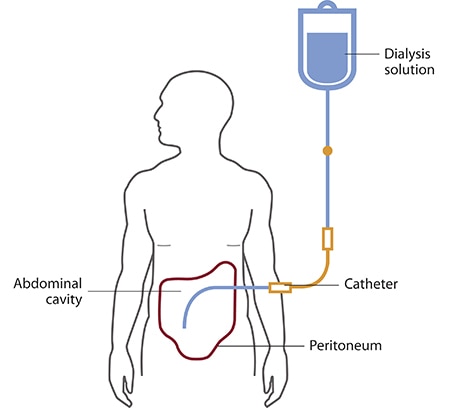
After a few hours, the solution and the wastes are drained out of your abdomen into the empty handbag. You can throw away the used solution in a toilet or tub. Then, you kickoff over with a fresh bag of dialysis solution. When the solution is fresh, information technology absorbs wastes rapidly. As time passes, filtering slows. For this reason, y'all need to repeat the process of emptying the used solution and refilling your belly with fresh solution four to 6 times every 24-hour interval. This process is called an exchange.
You can practice your exchanges during the twenty-four hours, or at night using a automobile that pumps the fluid in and out. For the best results, it is important that you perform all of your exchanges as prescribed. Dialysis tin assist you feel better and live longer, but it is non a cure for kidney failure.
How volition I feel when the dialysis solution is within my belly?
You may feel the aforementioned as usual, or y'all may feel full or bloated. Your abdomen may overstate a piddling. Some people need a larger size of clothing. You shouldn't feel whatsoever pain. Nearly people look and feel normal despite a belly full of solution.
What are the types of peritoneal dialysis?
You can choose the type of peritoneal dialysis that best fits your life:
- continuous ambulatory peritoneal dialysis (CAPD)
- automated peritoneal dialysis
The master differences between the two types of peritoneal dialysis are
- the schedule of exchanges
- i uses a machine and the other is washed past mitt
If one type of peritoneal dialysis doesn't suit yous, talk with your doctor near trying the other blazon.
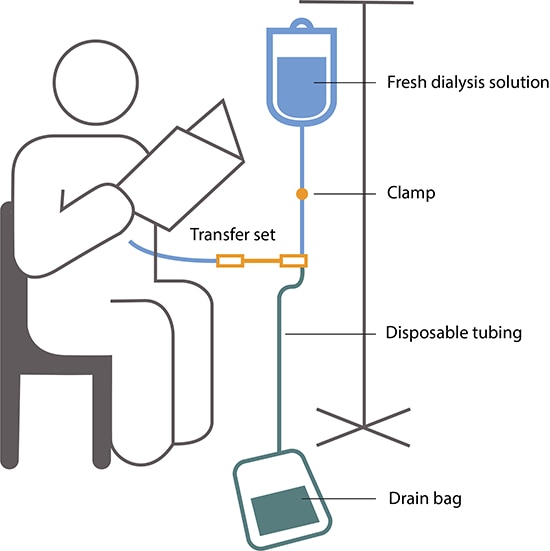
CAPD doesn't use a machine. You do the exchanges during the 24-hour interval by hand.
You tin do exchanges by paw in any make clean, well-lit place. Each substitution takes about 30 to 40 minutes. During an exchange, you can read, talk, sentry tv, or sleep. With CAPD, you go on the solution in your belly for iv to 6 hours or more. The time that the dialysis solution is in your abdomen is called the dwell fourth dimension. Usually, you change the solution at least four times a day and sleep with solution in your belly at nighttime. Y'all do not have to wake upward at night to practice an substitution.
Automatic peritoneal dialysis. A machine does the exchanges while yous sleep.
With automated peritoneal dialysis, a machine called a cycler fills and empties your belly three to 5 times during the night. In the forenoon, you begin the day with fresh solution in your abdomen. You lot may leave this solution in your belly all day or do one exchange in the middle of the afternoon without the motorcar. People sometimes call this treatment continuous cycler-assisted peritoneal dialysis or CCPD.
Where can I practise peritoneal dialysis?
You tin can practice both CAPD and automated peritoneal dialysis in whatsoever clean, private place, including at dwelling house, at work, or when travelling.
Before you travel, you tin have the manufacturer transport the supplies to where you're going so they'll be there when you get there. If you utilize automated peritoneal dialysis, y'all'll have to carry your motorcar with you lot or program to do exchanges by hand while y'all're abroad from home.
How practice I ready for peritoneal dialysis?
Surgery to put in your catheter
Before your first treatment, you will have surgery to place a catheter into your abdomen. Planning your catheter placement at least 3 weeks before your offset exchange tin can improve handling success.
Although you can use the catheter for dialysis as soon as information technology's in place, the catheter tends to work better when you have 10 to 20 days to heal earlier starting a full schedule of exchanges.
Your surgeon will make a modest cut, often below and a little to the side of your omphalos, and then guide the catheter through the slit into your peritoneal cavity. Yous'll receive general or local anesthesia, and you may need to stay overnight in the infirmary. Still, nigh people tin can go home after the procedure.
You'll learn to care for the skin around the catheter, called the exit site, as part of your dialysis preparation.
Dialysis grooming
After training, most people tin perform both types of peritoneal dialysis on their ain. You'll work with a dialysis nurse for 1 to two weeks to larn how to practise exchanges and avoid infections. Most people bring a family fellow member or friend to training. With a trained friend or family unit member, you'll be prepared in case you have a ill day and demand help with exchanges.
If you choose automated peritoneal dialysis, you'll larn how to
- set up the cycler
- connect the bags of dialysis solution
- identify the drain tube
If you choose automated peritoneal dialysis, yous also need to learn how to practise exchanges by hand in example of a power failure or if you lot need an exchange during the day in add-on to nighttime automated peritoneal dialysis.

How practice I perform an commutation?
You'll need the following supplies:
- transfer set up
- dialysis solution
- supplies to continue your get out site clean
If you lot choose automatic peritoneal dialysis y'all'll need a cycler.
Your wellness care team volition provide everything you demand to begin peritoneal dialysis and help yous arrange to have supplies such every bit dialysis solution and surgical masks delivered to your abode, usually once a month. Conscientious hand washing before and wearing a surgical mask over your nose and oral fissure while y'all connect your catheter to the transfer set can help forbid infection.
Utilize a transfer set to connect your catheter to the dialysis solution
A transfer set is tubing that you utilise to connect your catheter to the bag of dialysis solution. When you start go your catheter, the section of tube that sticks out from your peel will take a secure cap on the terminate to prevent infection. A connector under the cap will attach to whatever blazon of transfer ready.
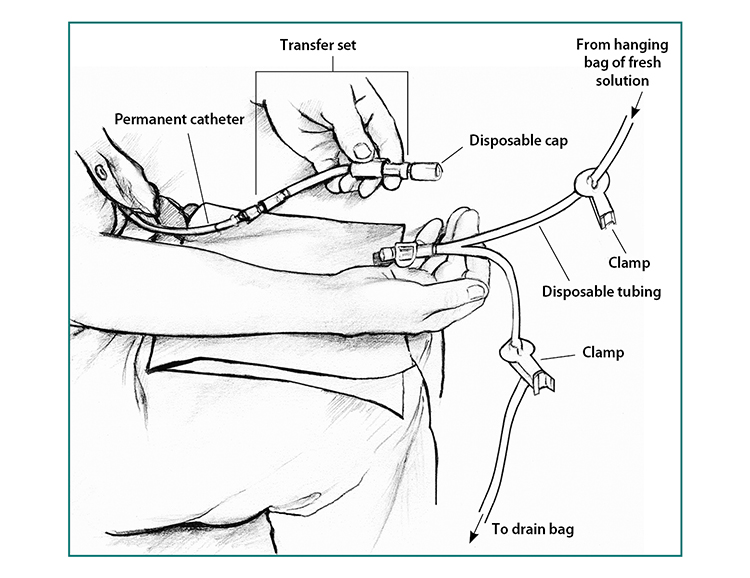
Between exchanges, you can keep your catheter and transfer set hidden inside your article of clothing. At the beginning of an exchange, you'll remove the disposable cap from the transfer set and connect the gear up to a tube that branches like the letter Y. One branch of the Y-tube connects to the drain bag, while the other connects to the handbag of fresh dialysis solution.
Use dialysis solution as prescribed
Dialysis solution comes in 1.5-, two-, ii.5-, or 3-liter numberless. Solutions comprise a carbohydrate chosen dextrose or a compound chosen icodextrin and minerals to pull the wastes and extra fluid from your blood into your abdomen. Unlike solutions have different strengths of dextrose or icodextrin. Your doctor volition prescribe a formula that fits your needs.
You'll need a clean infinite to shop your bags of solution and other supplies.
Doing an exchange by hand
- Afterwards you wash your hands and put on your surgical mask, drain the used dialysis solution from your belly into the drain bag. Most the end of the bleed, you may feel a mild tugging sensation that tells you most of the fluid is gone. Shut the transfer set.
- Warm each bag of solution to torso temperature before use. You can utilise an electric coating, or allow the pocketbook sit down in a tub of warm water. Most solution numberless come in a protective outer wrapper, and you can warm them in a microwave. Don't microwave a bag of solution after you have removed information technology from its wrapper.
- Hang the new handbag of solution on a pole and connect it to the tubing.
- Remove air from the tubes—permit a small corporeality of fresh, warm solution to flow directly from the new bag of solution into the drain handbag.
- Clamp the tube that goes to the bleed bag.
- Open up or reconnect the transfer set, and refill your belly with fresh dialysis solution from the hanging handbag.
Using a cycler for automated peritoneal dialysis exchanges
In automated peritoneal dialysis, you use a car chosen a cycler to fill and bleed your abdomen. You can program the cycler to requite you different amounts of dialysis solution at dissimilar times.
Each evening, you set the machine to practice three to five exchanges for you. You connect iii to five bags of dialysis solution to tubing that goes into the cycler—one purse of solution for each substitution. The machine may have a special tube to connect the pocketbook for the last substitution of the night.
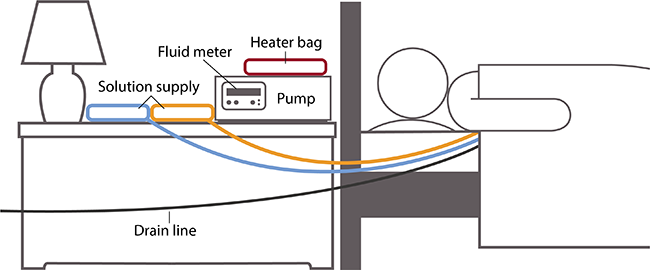
At the times yous ready, the cycler
- releases a clamp and allows used solution to bleed out of your belly into the bleed line
- warms the fresh dialysis solution before it enters your body
- releases a clamp to allow trunk-temperature solution to period into your belly
A fluid meter in the cycler measures and records how much solution the cycler removes. Some cyclers compare the amount that was put in with the amount that drains out. This feature lets you and your physician know if the treatment is removing enough fluid from your torso.
Some cyclers permit you to utilize a long drain line that drains directly into your toilet or bathtub. Others have a disposal container.
What changes will I have to make when I showtime peritoneal dialysis?
Daily routine
Your schedule will modify as you work your dialysis exchanges into your routine. If y'all do CAPD during the day, yous have some control over when yous do the exchanges. However, you'll however need to stop your normal activities and have virtually thirty minutes to perform an exchange. If you do automatic peritoneal dialysis, yous'll have to set up your cycler every night.
Physical activity
You may need to limit some physical activities when your belly is full of dialysis solution. You may still be active and play sports, merely you should discuss your activities with your health care team.
Brand changes to what you eat and drink
If yous're on peritoneal dialysis, you lot may need to limit
- sodium
- phosphorus
- calories in your eating plan
You lot may also need to
- watch how much liquid yous drink and eat. Your dietitian will help you lot determine how much liquid yous need to consume each day.
- add together protein to your nutrition considering peritoneal dialysis removes poly peptide.
- choose foods with the right amount of potassium.
- accept supplements made for people with kidney failure.
Eating the right foods can help y'all experience better while you're on peritoneal dialysis. Talk with your dialysis center's dietitian to find a repast plan that works for y'all.
Medicines
Your doctor may make changes to the medicines you lot take.
Coping
Adjusting to the effects of kidney failure and the time you spend on dialysis can exist difficult for both you and your family. Yous may
- have less energy
- demand to surrender some activities and duties at work or at home
A counselor or social worker can answer your questions and help you cope.
Take intendance of your go out site, supplies, and catheter to preclude infections
Your health intendance team will evidence you how to keep your catheter clean to prevent infections. Hither are some general rules:
- Store your supplies in a cool, clean, dry place.
- Inspect each bag of solution for signs of contamination, such as cloudiness, before you use it.
- Find a make clean, dry, well-lit infinite to perform your exchanges.
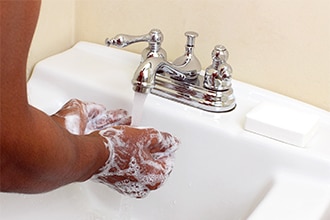
- Launder your hands every fourth dimension you need to handle your catheter.
- Make clean your peel where your catheter enters your body every twenty-four hour period, as instructed by your health care squad.
- Clothing a surgical mask when performing exchanges.
What are the possible bug from peritoneal dialysis?
Possible problems from peritoneal dialysis include infection, hernia, and weight proceeds.
Infection
One of the most serious problems related to peritoneal dialysis is infection. You tin can get an infection of the skin around your catheter leave site or yous tin develop peritonitis, an infection in the fluid in your abdomen. Leaner can enter your body through your catheter as you connect or disconnect information technology from the bags.
Seek immediate intendance if you accept signs of infection
Signs of an exit site infection include redness, pus, swelling or bulging, and tenderness or pain at the go out site. Health intendance professionals treat infections at the go out site with antibiotics.
Peritonitis may crusade
- pain in the abdomen
- fever
- nausea or vomiting
- redness or pain around your catheter
- unusual color or cloudiness in used dialysis solution
- the catheter gage to button out from your body—the cuff is the part of the catheter that holds it in place
Wellness care professionals treat peritonitis with antibiotics. Antibiotics are added to the dialysis solution that you tin usually take at abode. Quick treatment may forestall additional problems.
Hernia
A hernia is an area of weakness in your abdominal musculus.
Peritoneal dialysis increases your hazard for a hernia for a couple of reasons. Outset, you accept an opening in your musculus for your catheter. Second, the weight of the dialysis solution within your abdomen puts pressure on your muscle. Hernias can occur near your belly push, most the exit site, or in your groin. If y'all have a swelling or new lump in your groin or belly, talk with your wellness care professional.
Weight gain from fluid and dextrose
The longer the dialysis solution remains in your belly, the more than dextrose your body will blot from the dialysis solution. This can crusade weight gain over fourth dimension.
Limit weight gain
With CAPD, you might take a problem with the long overnight dwell time. If your body absorbs also much fluid and dextrose overnight, you may exist able to apply a cycler to exchange your solution in one case while yous sleep. This actress exchange will shorten your dwell time, keep your body from absorbing besides much fluid and dextrose, and filter more wastes and extra fluid from your body.
With automated peritoneal dialysis, yous may blot besides much solution during the daytime exchange, which has a long dwell time. You may need an actress exchange in the midafternoon to continue your trunk from absorbing too much solution and to remove more wastes and extra fluid from your body.
Your dietitian tin provide helpful guidance to reduce weight proceeds.
How will I know if my peritoneal dialysis is working?
To detect out if your dialysis exchanges are removing enough wastes, you'll have a claret test and collect used dialysis solution in one case a calendar month. If you're yet urinating, you may need to collect urine.
These tests help your doctor prescribe a dialysis schedule and dose to see your health needs. If your dialysis schedule isn't removing enough wastes or your body is absorbing likewise much dextrose, your md will make adjustments. Read about peritoneal dialysis dose and adequacy.
Source: https://www.niddk.nih.gov/health-information/kidney-disease/kidney-failure/peritoneal-dialysis
0 Response to "i am hold a bag up to my mouth and drink whats inside it seems to help"
Post a Comment